
BOS
Operations
Daily workflows, procedures, staff guidance, schedules, systems, forms, and operational resources.
BOS — Behavioral Operating System
BOS turns the operational knowledge required to run a behavioral health program into an organized system staff can actually use.
The Problem
Behavioral health programs rarely lack information. The information is simply scattered — and a staff member mid-shift has to guess which of a dozen places holds the answer.
When the answer is hard to find, staff improvise. Practice drifts, documentation gets inconsistent, and the same questions get asked on every shift.
The Approach
BOS is designed as an organized operational layer that sits across the program — connecting staff to the information, procedures, training, and systems they need, and pointing them to the right platform when the work belongs somewhere else.
It does not replace the tools a program already runs on. It makes them findable, and it holds the operational knowledge that currently lives in binders, inboxes, and people's heads.
Designed to be PHI-free
BOS is being designed around operational and workforce information rather than client medical records. That boundary is deliberate: it keeps the platform useful to every staff member without turning it into another place identifiable client information can accumulate.
This describes the design intent of the platform. It is not a legal opinion, a compliance certification, or a guarantee regarding HIPAA or any other regulatory requirement. Each organization remains responsible for its own privacy and security determinations.
Modules
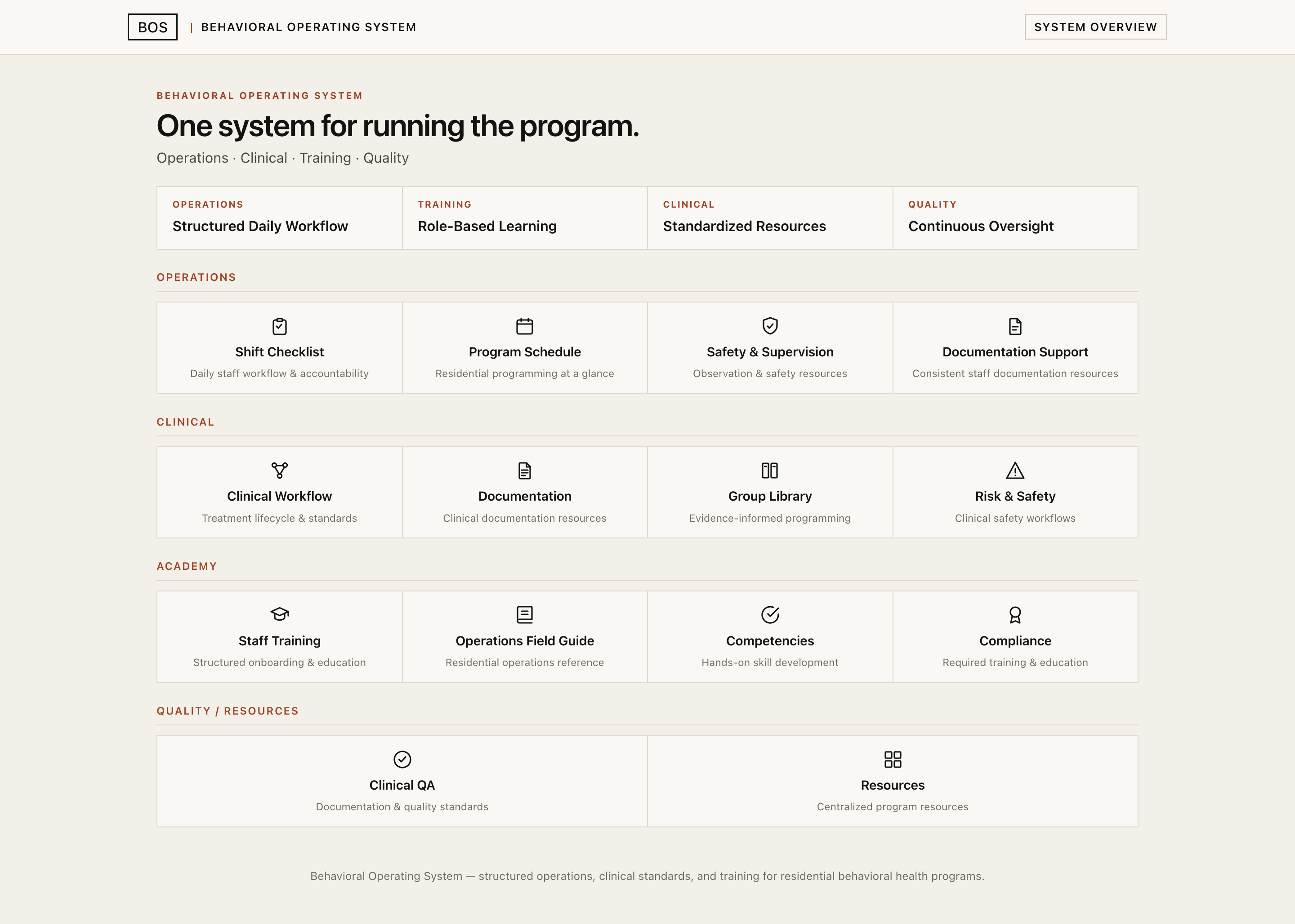
BOS is structured into modules that map to how a program actually operates. Modules are configured per program; not every module is enabled in every environment.
BOS
Daily workflows, procedures, staff guidance, schedules, systems, forms, and operational resources.
BOS
Orientation, training modules, system walkthroughs, role-specific education, and ongoing workforce development.
BOS
Emergency Quick Cards, emergency contacts, evacuation information, disaster response, and critical staff instructions.
BOS
Centralized access to program standards, regulatory resources, documentation expectations, and compliance guidance.
BOS
Staff onboarding, role expectations, announcements, contacts, and workforce resources.
BOS
An organized access point for the external technology and systems staff use to operate the program.
BOS is an actively developing platform. Module availability and functionality vary by program and by stage of implementation.
The Habit
When staff have a question about how the program operates, where something is located, what procedure to follow, or what to do next, BOS is designed to be the first place they look.
Spelled BOS Pronounced Boss
Architecture
BOS is built so the same operating structure can be deployed across different behavioral health programs, with the local details that make it specific to a site.
BOS Core
The structure that stays consistent from program to program.
Facility Configuration
The information that makes a BOS environment specific to one site.
Core is developed once and improves for every program. Configuration is what makes a BOS environment belong to a specific facility — and it stays private to that program.
Deployments
BOS environments can be configured around the workflows, procedures, systems, resources, and training needs of individual behavioral health programs.
Active Program
Residential Behavioral Health
A customized BOS environment supporting One Path’s residential operations, staff training, emergency response, program resources, and daily workflows.
Private program access — portal not yet published.
Next Step
BOS is developed by SoCalMHS and configured program by program. If you are building, restructuring, or scaling a behavioral health program and want to talk through what a BOS environment would look like for it, start a conversation.